
From the crew on board to the Italian Presidency, the crazy negotiation to hand over the aid destined for Gaza to the Catholic Church of Cyprus is conducted entirely in Italian. Yet the Flotilla has departed from Crete to challenge the naval blockade on Gaza, leaving behind some Italians.
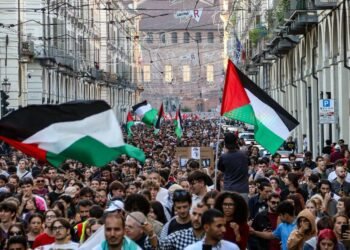
After the images of the numerous demonstrations on September 22 in support of the people of Gaza, we received the news that the boats of the Global Sumud Flotilla had been attacked by drones, with sound bombs and pepper spray. Some vessels sustained damage and were unable to continue their voyage. Amid the political statements about this vile Israeli attempt to intimidate the crew, Prime Minister Giorgia Meloni declared that the Italian government was negotiating with Israel to deliver the aid to Gaza through the Latin Patriarchate of Jerusalem, meaning the Catholic Church in the Holy Land.
According to this brilliant idea, the Flotilla should leave the aid in Cyprus, and the Church would take care of the rest. Thus began the wave of political outrage from the opposition, only for it to later emerge, through PD MEP Annalisa Corrado—on board the Flotilla—that negotiations with Cardinals Zuppi (Italian Bishops’ Conference) and Pizzaballa (Latin Patriarch of Jerusalem) were already underway “on their part.”
So, to recap, it’s unclear which Italians on board asked the Church for help, only to then express outrage when the government suggested handing over the baton to the auxiliary bishop of Cyprus (these are the statements made by Hon. Corrado on the PD’s website, which are at least partly incomprehensible).
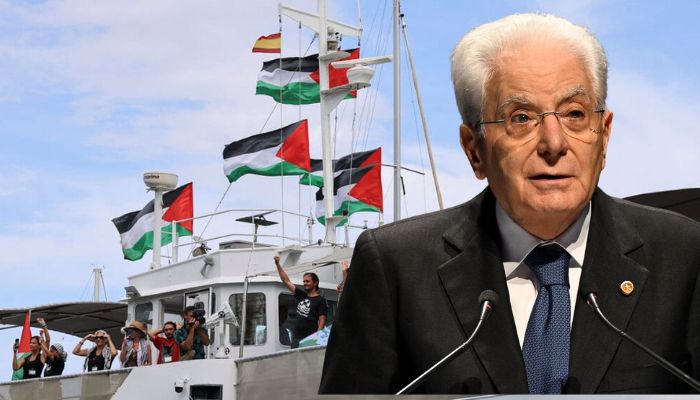
On Friday 26th, however, while the boats were in Crete, statements erupted from the Quirinale: President of the Republic Sergio Mattarella urged the Flotilla to accept the mediation of the Latin Patriarchate of Jerusalem. Inevitably, political acrobatics followed, distinguishing the Prime Minister’s proposal from that of the President of the Republic (two proposals identical in substance: leave the aid in Cyprus and go home), and the main opposition leaders, Giuseppe Conte and Elly Schlein, rushed to endorse the Quirinale’s words. What makes little sense is this entirely Italian attempt to give advice to the Flotilla, whose crew represents more than 40 different countries. Equally surprising is the Catholic Church suddenly claiming it can guarantee that the aid will reach Gaza, where people have been starving for months.
The Italian spokesperson of the crew, Maria Elena Delia, first published a video (from the ship) with a firm rejection of President Mattarella’s proposal, as if it hadn’t been some Italians on board themselves who had asked the Church for the mediation also promoted by the Italian Presidency. She then disembarked along with about ten Italians to return home. Delia declared she had abandoned the mission “in order to conduct a direct dialogue with the institutions to guarantee the safety of the Italian crew members and the achievement of the mission’s goals in accordance with international law.” It is unclear with whom she is supposed to be dialoguing and in what capacity; the fact remains that if the captain is always the last to leave the ship, the (now former) spokesperson was the first.
Meanwhile, the Flotilla set sail again for Gaza on Saturday, September 27. The vast majority of the crew, hailing from countries other than Italy, seem neither interested in nor even aware of this surreal negotiation which, if successful, would serve Israel’s interests by maintaining the naval blockade off the coast of Gaza without even the inconvenience of arresting activists who, now more than ever, enjoy strong support from global public opinion. Giorgia Meloni’s intervention therefore proved providential: by trying to claim credit, she made the “solution” unacceptable in the eyes of the opposition, to the point that not even Sergio Mattarella’s intervention has, so far, had any effect on the Italians on board. At least not on all of them, since some disembarked.
No criticism is intended here of those who, legitimately and understandably, decided to return home. But the overall image of Italy in this affair leaves a bitter taste—from the Quirinale to the crew, from those who stayed on the Flotilla to those who got off in Crete (apparently only Italians abandoned the mission, including journalist Ivan Grozny). One gets the sense of a uniquely Italian gray area, a sort of Italian glitch within the Flotilla (which of course does not concern all Italians on board).
Nor is it clear what role the Catholic Church—the greatest geopolitical power in history—thinks it is playing, for it cannot possibly fail to realize that the Global Sumud Flotilla is not simply delivering humanitarian aid (amounting to 50 tons, about two trucks’ worth). In recent hours, with the involvement of Sant’Egidio, Catholic pressure on the Flotilla has grown more insistent.
They will keep trying until the end to divert the expedition to Cyprus (which falls ecclesiastically under the jurisdiction of the Latin Patriarch in the Holy Land), perhaps relying on some Italian “bridgeheads” on board. They will continue to propose the “Corridor for Gaza Amalthea,” with a stopover in Cyprus and active since March 2024. If this corridor were actually working, while people in Gaza are starving, Cyprus would already be flooded with cargo ships bringing aid from around the world. The Flotilla’s goal, instead, is to challenge the naval blockade—something photojournalist Niccolò Celesti, among the Italians who abandoned, failed to grasp. In these times when war reporters work from home, perhaps he thought he was supposed to shoot a photo set for some influencer.